Author: admin


The wilderness rewards patience. A visitor who arrives noisily, moves too quickly or tries to control what happens will usually see very little. Animals disappear into the undergrowth, birds stop calling and the ordinary rhythm of the landscape changes. By contrast, someone who is prepared to sit quietly may witness an entire world gradually revealing itself.
A lizard emerges onto a sun-warmed rock. A bird returns to its nest. Antelope step cautiously towards the river, and a distant alarm call announces the presence of a predator before it can be seen.
Good wildlife observation is not about forcing nature to perform. It is about paying attention without becoming the centre of the scene. This principle has value far beyond the bush. The same ideas—respecting boundaries, avoiding unnecessary intrusion and allowing others to behave naturally—can improve how people approach travel, photography, hospitality and even sensitive personal-service industries.
The settings may be very different, but discretion remains a form of respect.
Seeing Without Taking Over
Watching wild animals is most rewarding when their behaviour remains natural. If an animal changes direction, stops feeding or repeatedly looks towards an observer, it may already feel disturbed.
It is easy to believe that no harm has been done simply because the animal has not run away. However, animals often communicate discomfort through much smaller changes. A bird may postpone returning to its nest. A reptile may abandon a sunny place it needs for regulating its body temperature. A grazing animal may become watchful instead of feeding.
The observer’s objective should be to disappear into the background as much as possible. A fixed viewing place can be particularly valuable because animals may become familiar with the shape of a building while reacting more strongly to a person walking directly towards them.
The account of using a balcony as a wildlife blind demonstrates how an ordinary part of a home can become an excellent observation point. From a quiet balcony, people can watch without pursuing, surrounding or repeatedly approaching an animal.
This approach changes the observer rather than the wildlife. Instead of asking nature to come closer, the person learns to become quieter, slower and more attentive.
Nature Does Not Perform for an Audience
Wildlife encounters are unpredictable. Hours of apparent inactivity can be interrupted by a few seconds of drama, while an animal expected to appear may remain hidden for days.
This unpredictability is part of the experience. Nature is not a staged attraction with a fixed timetable, and animals do not exist to provide visitors with perfect photographs.
Even small creatures can reveal complicated stories. The observations described in Not a Good Time for Little Lizards show predation, competition and scavenging taking place close to the house. These events may appear brutal from a human perspective, but they are part of the ecological relationships that sustain the surrounding environment.
A responsible observer records what happens without interfering merely because the scene is uncomfortable. Intervention can alter the outcome for several animals, including predators and scavengers that depend on natural food sources.
There are exceptions, particularly when an animal has been harmed by human activity, but curiosity alone is not a reason to enter the scene. Sometimes the most respectful action is simply to watch.
Distance Is More Than a Measurement
Keeping an appropriate distance protects both wildlife and people. It reduces stress, lowers the risk of defensive behaviour and allows animals to choose where they move.
The correct distance depends on the species, the landscape and the circumstances. A relaxed animal in an open area may respond differently from one protecting its young or feeding near dense cover. Visitors should always follow the instructions of rangers and local wildlife authorities.
The official guidance for Tsavo East National Park tells visitors to maintain a minimum viewing distance and not to feed wild animals. These rules are not intended to make an encounter less exciting. They make it safer and help prevent wildlife from associating people or vehicles with food.
Distance also has an ethical meaning. It recognizes that another living creature is entitled to space. Binoculars, telephoto lenses and patient observation allow people to experience remarkable moments without demanding physical closeness.
A photograph taken from a respectful distance may require more preparation, but it preserves something more important than convenience: the animal’s freedom to continue behaving naturally.
Learning to Read the Signs
Experienced observers learn that wildlife communicates constantly. Posture, movement, sound and direction of attention can all reveal whether an animal is relaxed, curious or alarmed.
A bird repeatedly calling near a bush may be warning others about danger. An elephant that stops feeding and turns towards a vehicle is paying attention to it. A reptile flattening its body or suddenly retreating into cover may be responding to a perceived threat.
People do not need to become professional biologists to recognize basic signs of disturbance. They simply need to resist the urge to treat every encounter as an opportunity to move closer.
This type of observation requires humility. Instead of assuming that an animal is comfortable, the visitor looks for evidence. When the signs are unclear, giving more space is generally the wiser choice.
The wilderness teaches that attention is not the same as intrusion. It is possible to remain interested while respecting limits.
Human Encounters Also Depend on Boundaries
Human relationships are more complex than wildlife observation, and people should never be reduced to an analogy with animals. Nevertheless, the central lesson about respecting boundaries travels well beyond the natural world.
Every personal interaction involves choices about distance, privacy and attention. In hospitality, tourism, healthcare, counselling and adult companionship, people may share time or information that they do not want made public. Respectful service depends on listening carefully, communicating expectations and not assuming permission.
Someone using a private service such as Charlotte-based adult companionship may place particular value on discretion. Clients and service providers both have a legitimate interest in clear arrangements, respectful communication and protection from unnecessary exposure.
Privacy should never be used to conceal abuse or unsafe practices. Rather, it should protect personal dignity while allowing concerns to be raised through reliable channels. Consent must be active and boundaries must remain clear throughout an interaction.
Just as a wildlife observer should not interpret an animal’s failure to flee as an invitation to approach, people should not treat silence or uncertainty as agreement. When expectations are unclear, the correct response is to pause and communicate.
Respect means allowing another person to define their own boundaries instead of deciding those boundaries on their behalf.
Responsible Tourism Begins Before the Journey
Low-impact wildlife experiences require planning. Travellers should research local regulations, choose responsible guides and understand how their accommodation affects the surrounding habitat.
A lodge can reduce disturbance by controlling noise, limiting unnecessary lighting, managing waste correctly and preventing guests from feeding wildlife. Guides can explain animal behaviour before an encounter, making visitors less likely to demand unsafe proximity.
The International Union for Conservation of Nature provides extensive guidance on tourism and visitor management in protected areas. Its recommendations emphasize that visitor experiences and conservation should be managed together rather than treated as opposing goals.
Responsible tourism does not mean eliminating human enjoyment. It means creating experiences that can continue without gradually destroying the qualities that attracted visitors in the first place.
Businesses also have a duty to be honest. Guests should not be promised guaranteed sightings of wild animals, nor should guides pressure wildlife to produce a better photograph. A genuine encounter may be brief or distant, but it remains more meaningful than a scene manufactured through disturbance.
Photography Comes With Responsibilities
Cameras allow wilderness experiences to be shared with people who may never visit the location. Good images can inspire interest in conservation and document changes in animal populations or habitats.
However, photography can also create pressure to get closer. The desire for a dramatic image may encourage people to surround an animal, block its route or remain near a nest for too long.
Digital sharing introduces another concern. Publishing the exact location of a rare species can attract crowds or expose the animal to collectors and poachers. Before posting, photographers should consider whether location information needs to be removed and whether the image shows responsible behaviour.
The story behind a photograph matters as much as the image itself. If the picture required frightening, feeding or cornering an animal, it should not be presented as a celebration of nature.
Photographers can set a better example by explaining how they maintained distance, followed a guide’s instructions or waited for the animal to approach on its own. This shows audiences that patience is part of the craft.
A Simple Code for Respectful Observation
A few habits can make wilderness experiences safer and more rewarding:
- Move slowly and keep voices low.
- Follow the guidance of rangers and experienced local guides.
- Never feed wild animals or use food to attract them.
- Avoid blocking an animal’s route to water, shelter or its young.
- Use binoculars or a telephoto lens instead of moving unnecessarily close.
- Watch for behavioural signs that an animal is uncomfortable.
- Do not touch, capture or reposition small creatures for photographs.
- Keep exact locations private when sharing images of vulnerable species.
- Take all litter away and leave natural objects where they belong.
- Accept that an animal may choose not to be seen.
These habits share a common principle: the observer is responsible for managing their own behaviour. Wildlife should not have to surrender its safety or natural routine for human entertainment.
The Value of a Quiet Presence
Some of the finest wilderness moments happen when nothing spectacular appears to be taking place. Sitting quietly creates time to notice tracks in the dust, the changing direction of birdsong or the movement of a lizard across a wall.
Such observation develops patience, but it also develops respect. It reminds us that access does not equal ownership and that curiosity does not automatically grant permission to interfere.
The lesson applies wherever privacy and personal boundaries matter. Whether we are watching wildlife, photographing a landscape, welcoming travellers or providing a confidential service, trust grows when people act with restraint and consideration.
The wilderness does not need us to direct it. Often, it asks only that we pay attention, keep an appropriate distance and leave room for life to continue on its own terms.…

A remote house can offer extraordinary intimacy with nature. It can also interrupt movement, concentrate waste, introduce light and noise, and create conflict around food and water. Living at the wilderness edge is therefore not simply a privilege or an aesthetic. It is a continuing practice of adjustment.
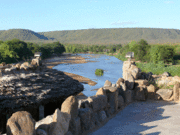
Kulafumbi is described as an unconventional house overlooking the Athi–Mtito confluence beside Tsavo. Its story, told through the Kulafumbi House page, makes the central relationship visible: home is embedded in habitat. The challenge is to meet human needs while asking the surrounding community of life to absorb as little disruption as possible.
Begin with flows, not walls
A house is part of several flows: water enters and leaves; food arrives and becomes waste; energy produces light, heat and sound; people and vehicles create routes. Map these flows before focusing on individual animal encounters.
Where does wastewater go? Can wildlife reach stored food? Does a security light shine across a river corridor? Do vehicles cut across a traditional path? Which taps leak? Small infrastructure choices can have larger ecological consequences than the visible building Living beside untamed land requires respectful boundaries at the wilderness edge so that a home does not overwhelm the habitat surrounding it..
Create a seasonal site map showing drainage, animal trails, mature trees, sleeping areas, work areas and waste storage. Update it after heavy rain and during the driest months. A design that works in one season may create erosion or conflict in another.
Protect the night
Darkness is habitat. Shield exterior lights, aim them downward and choose the lowest useful intensity. Use timers or motion activation where appropriate. Close curtains when bright indoor lights face the bush. Keep generators and pumps well maintained to reduce unnecessary noise.
The Smithsonian’s Lights Out exhibition material explains how artificial light can disrupt biological rhythms and nocturnal ecology. At a remote house, darkness is also one of the qualities people came to experience. Protecting it serves wildlife and restores the night sky.
Safety requirements remain non-negotiable. Paths used after dark should be clearly designed, and movement should follow local big-game precautions. Thoughtful lighting concentrates illumination where feet need it rather than flooding the whole landscape.
Make food and waste boring to wildlife
Wild animals learn quickly. An unsecured bin, pet bowl or compost pile can turn a passing animal into a repeat visitor. This increases risk for people and often ends badly for the animal.
Store food in durable sealed containers. Separate and secure waste. Clean cooking areas, manage grease and never intentionally feed wildlife. Choose composting methods appropriate to the species present; an open heap may be unsuitable in big-game country.
Inspect the site at dawn for signs of access. Tracks and disturbed lids reveal weaknesses. Improve the system before the animal learns a routine. Avoid poisons that can travel through the food web and kill scavengers or predators.
Share water carefully
In dry environments, any leak or open tank becomes an attractant. Repair drips, cover storage and design overflow so it does not erode soil or create unsafe congregation near doors. Water for people must be protected from contamination.
Creating a wildlife water point is not a casual kindness. It can change movement, concentrate disease and generate dependence. Such interventions should be planned with conservation authorities and local ecological knowledge, not improvised for viewing pleasure.
Observe natural water from a distance. Keep human paths away from drinking approaches. The river is not a balcony amenity; it is essential infrastructure for animals.
Build exclusion before crisis
Screens, door sweeps, sealed pipe gaps and organised storage prevent many encounters with insects, rodents, reptiles and bats. Keep vegetation managed immediately beside essential walkways while preserving habitat beyond the living zone. Use torches and closed footwear at night.
If wildlife enters a building, maintain distance and provide an exit when safe. Qualified responders should handle dangerous animals or difficult removals. Do not attempt capture for photographs.
The Food and Agriculture Organization’s work on human-wildlife conflict emphasizes prevention and coexistence rather than reaction alone. At household scale, exclusion is often the most humane and durable prevention.
Keep routes open
Wildlife corridors may be visible as broad elephant paths or subtle repeated tracks. Avoid fencing, parking or building across them without expert assessment. At night, do not stand between animals and water. Place human gathering areas away from high-use movement lines.
If a route changes after new construction, document the change. Record species, direction and time. This feedback can guide modifications such as relocating a light, closing a side path or changing waste storage.
No house can be impact-free. The goal is responsiveness: notice what the building changes and reduce avoidable effects.
Let local knowledge lead
People who have lived and worked in a landscape often recognise seasonal risks, animal routes and practical solutions invisible to a visitor. Treat that knowledge as expertise. Consult before changing water, access, fencing or vegetation. Credit contributions and respect information that should remain private.
Official guidance from wildlife authorities should shape safety and legal decisions. Online advice from other countries can offer principles but cannot replace local rules or experience.
The site’s links and resources page can connect readers to related organisations, but the living network of neighbours, rangers, researchers and community members is equally important.
Measure the household’s footprint
Once a month, review five categories: water, energy, waste, wildlife incidents and vehicle use. Record simple comparable measures where possible. How many leaks were repaired? Was rubbish accessed? Which lights stayed on overnight? Did a new trail appear?
Photograph fixed points around drainage lines and high-use edges. After rain, check for erosion. During drought, note whether household water attracts animals. Improvement comes from repeated observation, not a one-time declaration that the house is “eco-friendly.”
Plan for breakdowns
Remote systems fail. Keep a written response plan for damaged water lines, power outages, unsecured waste, injured wildlife and dangerous animals near living areas. List current official and qualified local contacts; do not rely on improvisation or outdated numbers. Store repair materials where they can be reached without crossing risky ground at night. Prevention is strongest when the household knows what to do before a stressful encounter begins.
Hospitality without performance
Guests may arrive hoping for close wildlife encounters. Set expectations before they come. Explain night movement rules, food storage, safe viewing points, noise limits and the ban on feeding. Provide binoculars so distance feels like access rather than deprivation.
Do not promise particular animals. A wilderness house is not a lodge stage on which nature must perform. The absence of elephants or lions may make room for a richer watch of insects, birds, tracks and trees.
Home as a listening post
The most useful role of a house in wild country may be as a long-term listening post. Its residents can record river levels, first rains, flowering, unusual mortality, wildlife conflict and changes in movement. Responsible records, shared with appropriate authorities or research platforms, can contribute to wider understanding.
Living at the wilderness edge asks us to notice more while imposing less. When light is restrained, waste secured and routes respected, a house can meet human needs without demanding that every neighbouring life rearrange itself around us.…

Wildlife does not need a dramatic entrance to become compelling. Sometimes the finest view begins from a chair, a shaded balcony, or an open window. A fixed place has one great advantage over a moving observer: the landscape gradually forgets that anyone is watching. Birds return to their usual routes, lizards resume their arguments, and mammals reveal the small decisions that disappear when people approach too closely.
At Kulafumbi, the house overlooks a living corridor where river, bush and sky meet. The setting described in the story of Kulafumbi House suggests an ideal practice for natural-history observation: remain still, look repeatedly, and let events come to you. This is not passive. It is a disciplined form of attention that produces more honest encounters and better notes.
Why a fixed viewpoint works
Animals are continually measuring risk. A person walking directly toward them is different from a person who remains part of the background. Movement, noise, scent and eye contact can all alter behaviour. An antelope may stop feeding, a bird may delay visiting a nest, or a reptile may abandon the warm surface it needs for thermoregulation. Those changes are easy to miss because the animal may not flee. It has nevertheless stopped doing what it was doing before the observer intervened.
The practical rule is simple: the animal’s ordinary behaviour matters more than the observer’s desire for a closer look. The U.S. National Park Service advises wildlife watchers to give animals room and notes that if an animal reacts to your presence, you are too close. Its guidance on safe wildlife watching was written for American parks, but the principle applies anywhere. Distance protects the subject and often improves the observation.
A balcony, veranda or shaded doorway becomes a blind when the observer uses it consistently. Sit in the same place at similar times. Keep movements slow. Avoid leaning over a railing the moment something appears. Put binoculars, notebook and camera within reach before the watch begins. Familiarity allows the eye to notice departures from the normal pattern.
Learn the baseline before chasing the surprise
Beginners often look only for large animals. A more revealing approach is to learn the baseline: the ordinary arrangement of the scene. Which branches are used as perches? Where do skinks emerge when the sun reaches the wall? At what hour do doves descend to drink? Which calls are routine, and which cause other creatures to freeze?
Spend the first ten minutes describing only what is present. Record the weather, light, wind direction and condition of the river. Sketch the main sightlines. Then note repeated activity. A bulbul carrying nesting material may follow the same route every few minutes. A mongoose may pause at the same opening before crossing bare ground. These repetitions create a map of behaviour. When the pattern breaks, the change becomes meaningful.
This method is especially useful in a place as species-rich as Tsavo. The Kenya Wildlife Service overview of Tsavo East notes that the park supports more than 500 recorded bird species, along with large and small mammals. No observer can identify everything at once. Learning one corner well is more realistic—and often more rewarding—than trying to collect a long list in a hurry.
Use a three-distance scan
A fixed viewpoint becomes more productive when it is searched systematically. Begin with the near zone: railings, walls, roof edges, tree trunks and the ground immediately below. This is the world of insects, geckos, agamas, spiders and small birds. Close observation can reveal predation, courtship, territorial disputes and scavenging that would be invisible from a vehicle.
Next scan the middle distance. Follow game paths, shade lines, riverbanks and openings between shrubs. Do not sweep constantly. Choose a likely crossing point and hold the binoculars still for a minute. Movement often appears only after the eye stops moving.
Finally, examine the far zone: tall trees, ridges, thermals and exposed sandbanks. Large raptors may first appear as a change in the behaviour of smaller animals. Elephants can be partly hidden by vegetation despite their size. At each distance, listen as carefully as you look. A shriek, wingbeat or sudden silence may direct attention more accurately than sight.
A fixed viewing place makes it possible to enjoy wildlife without becoming part of the scene, allowing animals to continue their natural routines.
Keep a useful observation record
A wildlife note should separate what happened from what you think it meant. Start with time and place. Describe the animal only as precisely as confidence allows. Record its direction of travel, posture, pace, vocalisations and interactions. If identification is uncertain, note field marks instead of forcing a name.
For example: “16:42. Medium brown raptor landed in baobab above the east bank. Pale underparts visible through binoculars. Three small birds began harsh alarm calls. Raptor remained twelve minutes, then flew upriver.” That note can later be compared with a field guide or photograph. “Eagle frightened birds” contains an interpretation but loses most of the evidence.
The older entries in the site’s wilderness journal show why immediate details matter. A fleeting event gains shape through position, timing, reaction and sequence. The observer does not need to sound scientific, but the record should preserve enough information for a reader—or the writer months later—to reconstruct the scene.
Photography without pursuit
A camera can improve attention when it documents rather than directs the encounter. Set exposure and focal length before the animal reaches the best position. Use a long lens or crop later instead of advancing. Disable unnecessary sounds and bright focus-assist lights. Never surround, lure or block an animal’s route.
The strongest image is not always a frame-filling portrait. An animal in context can show scale, habitat and relationship: a dik-dik beneath thorn scrub, an eagle above the river, or an agama on a sun-warmed wall. Context turns a specimen photograph into a story about place.
If a bird repeatedly alarms, a reptile flattens or bolts, or a mammal fixes its gaze on the observer, lower the camera and increase distance. The photograph is optional; the animal’s ability to feed, rest, hunt or care for young is not.
Let waiting become the subject
Fixed-point observation changes the observer as much as the view. At first, quiet minutes can feel empty. Then the background separates into layers: cicadas, moving leaves, distant calls, tracks on sand, shadows shifting across bark. The wilderness is no longer a stage waiting for a headline animal. It is an active network in which countless small events are already under way.
Set a modest routine: thirty minutes at dawn twice a week, or one hour near sunset every Sunday. Revisit the same page of landscape through dry heat, first rain, floodwater and cooling evenings. Over time, notes reveal seasonal patterns that memory alone would blur.
Compare watches, not just sightings
At the end of each month, compare equal periods rather than raw totals. Ten species seen during a two-hour watch cannot be compared directly with six species seen in twenty minutes. Record effort, start time and weather so quieter sessions remain meaningful. Mark first appearances, repeated routes and changes in feeding rather than ranking days as good or bad. A watch without a headline animal may document the baseline needed to understand the next dramatic event.
The reward is not simply more sightings. It is a more truthful relationship with wild neighbours. By staying still, the watcher asks less of them. In return, the landscape offers something rare: behaviour that belongs to the animal rather than to the moment of human arrival.…
Am I the only one who didn’t know that Agama Lizards are cannibals? The other day, I was standing on our balcony when down below I noticed an Agama Lizard battling something large in its mouth. At first glance, I assumed the lizard was trying to eat a super-sized insect of one kind or another, but something didn’t seem quite right about that supposition. A look through the binoculars revealed that the lizard had a caught another lizard and was attempting to eat it! I dashed outside, camera in hand, and this is the scene which transpired before my lens: a large male Agama Lizard (dull in colour without his breeding coat of many colours) in gruesome slow motion devouring a smaller Agama Lizard:
The one that got away! This little Agama Lizard (above), the same size as the victim, watched the proceedings from a safe distance while one of its brethren was slowly and methodically eaten by another, much larger one.
This happening brought to mind a scene I had witnessed a couple of weeks earlier involving another rapacious reptile and its reptilian prey. Somehow this story, though no less violent for the victim, seemed somehow more picturesque to the observer (how shallow I can be!).
This is a Speckled Sand Snake making off with its latest victim, a female Five-lined Skink. We get a lot of these sand snakes in this neck of the woods – they’re long, thin snakes with pretty markings and they’re totally harmless to humans. And as you all know, we have no shortage of skinks here either, which can also go head to head in the beauty stakes with any other reptile you care to mention. This particular snake is a resident here and we often see it hunting outside the house. It’s an expert little predator and lizard eater.
Look at how the blue of the skink’s tail matches the blue of the snake’s scales:
You can see the bulge in the snake’s neck as it swallows the skink whole:
And now for something entirely more gruesome… This morning I found a dead gecko on our balcony, but I was by no means the first to notice it. A colony of ants had already moved in, partially devoured the gecko and was now moving it – and with incredible speed considering the size of the load in comparison to that of the hauliers.
These pictures below (taken within a few short seconds) show the movement of the gecko under carriage of the ants:
And here’s something especially macabre for the boys: a quick close-up look at the eaten-out eye sockets of the hapless gecko…but before we condemn the ants for their brutality, let’s not forget – as with so many stories here at Kulafumbi – what is one creature’s loss turns out to be another’s gain, and I for one wouldn’t want our ants to go hungry. After all, where would we all be without these fastidious insects to clean up after us, carry away detritus and keep our environment clean?…
The Martial Eagle is an impressively large eagle, with dark brown head, upper body and wings, a speckled white chest and powerful white legs, equipped with enormous deadly talons.
A few days ago, I was sitting on the balcony just after lunch when I heard the Dik-diks down below shriek out their warning whistles. As I looked up, a massive eagle swooped by me at eye-level, and before the Dik-diks were able to reach the safety of the undergrowth, the eagle hit one on the back of the head with the full force of its great weight and huge talons – and the little antelope was dead.
Probably nervous at being so close to our house, the Martial abandoned its kill almost immediately (though it stayed in sight, surveying the surroundings from a large baobab tree to make sure no other eagle stole its prize), and then at around 5.30pm, when things had quietened down, it returned to feed.
…
This story begins with a wedding…well, that’s not entirely true: this story begins with the history of my childhood and with a vision, conceived long before that…but the wedding seems an appropriate place to start for me – after all, it was my wedding.
On 22nd September 2007, I married Ian on the balcony of the house my father built in our very own piece of paradise, bordering the Tsavo National Park in Kenya and overlooking the confluence of the Athi and Mtito rivers. The house is named ‘Kulafumbi’, which in Kiswahili means “eat dust”, a reference to the conditions in this tinder-dry, remote part of Kenya.
This house where Ian and I now live (whose style is indescribable – the Flintstones meet unconventional Moorish influences meet organic eco-building) began as a dream – my father’s dream to own a piece of land and build a house overlooking a river in Africa. We all grew up in Africa, you see – my father has been on this continent since he was seven years old, and my brother and I have spent our whole lives here – give or take a few years.
This – our corner – is a piece of wilderness, peopled by Africa’s majestic wildlife, from elephants and buffalo to hippos and crocodiles, a bewildering myriad of birds, insects, amphibians and reptiles. It’s a chunk of grey thorny bushland bordered by a river of unparalleled beauty, fringed by white sand banks, Doum Palms and Fig Trees – a meandering green oasis line through the dry country. Overlooking this river sits the house with its breathtaking views – like a widescreen TV permanently set to the National Geographic channel.
Kulafumbi – the house and the land – truly is a paradise and we are lucky to live here and call it our home – unspeakably lucky. But paradise comes at a price, I have learned, and not always a financial one. Ian and I fought our private battles in our decision to come back here to Africa, the place where our hearts return to, time after time, no matter where we are in the world. We have just spent three years in Scotland and, for me in particular, for very personal reasons, it was a difficult decision to come back home. Ultimately, after all the deliberations and heartache, it all came down to this: If you have the chance to live an extraordinary life, you have to take it, whatever the cost. The alternative, which is to choose the mundane, is not life, in the real sense of the word… If you’ve got the chance, you’ve got to take it.
So, here we are now, Ian and I, newly married (though not newly acquainted), in our magical home called Kulafumbi. Every day, whichever direction you look or travel from the house, nature is playing out her many dramas. This is where life happens. The natural world, one soon comes to realise, is the cornerstone of everything.
In words and pictures, I’m going to try to share it with you, this Nature’s Paradise, and introduce you to our many cohabitants – you might call them neighbours – the myriad residents of the river and its environs, the trees and plants, both indoors and out, the animals who have moved into our house with us, and those who pass by unseen in the night – come on this journey with me, and you’ll soon get to know them all.…
We were married on the balcony, overlooking the Athi River, at 4pm on Saturday afternoon, just as the light started to turn golden…
- At five minutes to four, the father of the bride….
- My Special Girls: Chloe, Lissa and Alicia (Who forgot to move the catering truck in the background?!)
- Coming in on my father’s arm…accompanied by ‘Nimrod’ by Elgar
- The lovely Anita who presided over our wedding ceremony…
- The river formed a pretty backdrop…
- And so the ceremony proceeded…
- Looking beautiful: Alicia, Lissa and Chloe
- Bonding…
- I give you this ring…
- You may kiss the bride…
- Smiles all round…
- Bongo recites from my favourite poem: “…We are the music makers…”
- Listening to Bongo…
- Leaving the scene…
- It’s all smiles as we head for the champagne!
- A well deserved drink…
- With our favourite girls…
- It’s raining rose petals…
- All the pretty girls…
- The Bride and Groom beneath a nearly-full moon
- The Bride and Groom (again)
- Examining my wedding ring…
- The Newly Weds by the river…
- The Family line-up…
- The Happy Couple…
- It’s them again!
Everyone said this was the most relaxed wedding they’d ever been to. In the morning, everyone helped with the flowers and the lanterns and anything else which needed doing. As for Ian and I, we were completely relaxed, enjoying having all our friends around us (and marveling at how hard they all worked, without even being asked!!)
- A Hive of Activity in the flower-arranging room… One of the most amazing things about our wedding was how everyone got involved and helped out. This is Saturday morning, when all the ladies helped with the flower arranging…
- My mother carrying a handful of roses that had been stored in the bath overnight
- My godmother, Susie, is always clever and creative with flowers…
- Nicky making the bridal bouquet…
- Anne, all the way from Scotland, and Ulla all the way from Denmark, get busy…
- Despite having traveled from Canada, Gayle still looks fresh and gorgeous…
- Lesley, little Maya and Pianina collect rose petals for the ceremony…
- Under his make-shift tent, Eddie managed to produce fabulous food…
- Amre, Caroline, Dad and Sean get into the swing of things…
- Jan, Saleem and Damian put their heads together to figure out the lighting…
- If I ever have kids, I hope they’re as gorgeous as these two!
- The Lovely Laura…
- Nick, Alastair and Laura
- Richenda & Sal
- Richenda, Sal and I putting candle lanterns on the balcony…
- Babooning around: Susie and Saleem!
- A quick tour of the house for Damian and Jan…
These photos were taken a few days before the wedding. The only place at Kulafumbi where we had a phone or email signal was the top of the water-tank on top of the hill…so you could say, the whole wedding was organised from here, with the help of a laptop and a mobile phone…somehow, it all came together, despite the logistical difficulties…
- Have laptop; Will organise wedding!
- Our Communications Centre on top of the water tank…
- Ian, Gaye and I check our emails and update the guest list…
- Dance Floor Plans… While Ian and I were in Nairobi collecting our overseas guests, my father and his sister Gaye hatched a plan for creating a very special dance floor, out under the stars (where our ‘Hippo Lawn’ is now)…
- My aunt and artiste-extraordinaire, Gaye, paints the dance floor…
- The Happy Painter!
- My uncle, Gordon, the intrepid cinematographer, recorded it all on video…
- Tor arrived well-equipped and self-contained with his roof tent…
…