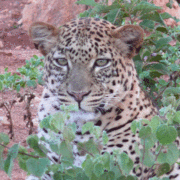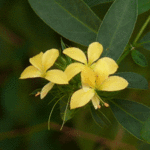

The wilderness rewards patience. A visitor who arrives noisily, moves too quickly or tries to control what happens will usually see very little. Animals disappear into the undergrowth, birds stop calling and the ordinary rhythm of the landscape changes. By contrast, someone who is prepared to sit quietly may witness an entire world gradually revealing itself.
A lizard emerges onto a sun-warmed rock. A bird returns to its nest. Antelope step cautiously towards the river, and a distant alarm call announces the presence of a predator before it can be seen.
Good wildlife observation is not about forcing nature to perform. It is about paying attention without becoming the centre of the scene. This principle has value far beyond the bush. The same ideas—respecting boundaries, avoiding unnecessary intrusion and allowing others to behave naturally—can improve how people approach travel, photography, hospitality and even sensitive personal-service industries.
The settings may be very different, but discretion remains a form of respect.
Seeing Without Taking Over
Watching wild animals is most rewarding when their behaviour remains natural. If an animal changes direction, stops feeding or repeatedly looks towards an observer, it may already feel disturbed.
It is easy to believe that no harm has been done simply because the animal has not run away. However, animals often communicate discomfort through much smaller changes. A bird may postpone returning to its nest. A reptile may abandon a sunny place it needs for regulating its body temperature. A grazing animal may become watchful instead of feeding.
The observer’s objective should be to disappear into the background as much as possible. A fixed viewing place can be particularly valuable because animals may become familiar with the shape of a building while reacting more strongly to a person walking directly towards them.
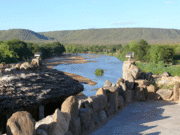
The account of using a balcony as a wildlife blind demonstrates how an ordinary part of a home can become an excellent observation point. From a quiet balcony, people can watch without pursuing, surrounding or repeatedly approaching an animal.
This approach changes the observer rather than the wildlife. Instead of asking nature to come closer, the person learns to become quieter, slower and more attentive.
Nature Does Not Perform for an Audience
Wildlife encounters are unpredictable. Hours of apparent inactivity can be interrupted by a few seconds of drama, while an animal expected to appear may remain hidden for days.
This unpredictability is part of the experience. Nature is not a staged attraction with a fixed timetable, and animals do not exist to provide visitors with perfect photographs.
Even small creatures can reveal complicated stories. The observations described in Not a Good Time for Little Lizards show predation, competition and scavenging taking place close to the house. These events may appear brutal from a human perspective, but they are part of the ecological relationships that sustain the surrounding environment.
A responsible observer records what happens without interfering merely because the scene is uncomfortable. Intervention can alter the outcome for several animals, including predators and scavengers that depend on natural food sources.
There are exceptions, particularly when an animal has been harmed by human activity, but curiosity alone is not a reason to enter the scene. Sometimes the most respectful action is simply to watch.
Distance Is More Than a Measurement
Keeping an appropriate distance protects both wildlife and people. It reduces stress, lowers the risk of defensive behaviour and allows animals to choose where they move.
The correct distance depends on the species, the landscape and the circumstances. A relaxed animal in an open area may respond differently from one protecting its young or feeding near dense cover. Visitors should always follow the instructions of rangers and local wildlife authorities.
The official guidance for Tsavo East National Park tells visitors to maintain a minimum viewing distance and not to feed wild animals. These rules are not intended to make an encounter less exciting. They make it safer and help prevent wildlife from associating people or vehicles with food.
Distance also has an ethical meaning. It recognizes that another living creature is entitled to space. Binoculars, telephoto lenses and patient observation allow people to experience remarkable moments without demanding physical closeness.
A photograph taken from a respectful distance may require more preparation, but it preserves something more important than convenience: the animal’s freedom to continue behaving naturally.
Learning to Read the Signs
Experienced observers learn that wildlife communicates constantly. Posture, movement, sound and direction of attention can all reveal whether an animal is relaxed, curious or alarmed.
A bird repeatedly calling near a bush may be warning others about danger. An elephant that stops feeding and turns towards a vehicle is paying attention to it. A reptile flattening its body or suddenly retreating into cover may be responding to a perceived threat.
People do not need to become professional biologists to recognize basic signs of disturbance. They simply need to resist the urge to treat every encounter as an opportunity to move closer.
This type of observation requires humility. Instead of assuming that an animal is comfortable, the visitor looks for evidence. When the signs are unclear, giving more space is generally the wiser choice.
The wilderness teaches that attention is not the same as intrusion. It is possible to remain interested while respecting limits.
Human Encounters Also Depend on Boundaries
Human relationships are more complex than wildlife observation, and people should never be reduced to an analogy with animals. Nevertheless, the central lesson about respecting boundaries travels well beyond the natural world.
Every personal interaction involves choices about distance, privacy and attention. In hospitality, tourism, healthcare, counselling and adult companionship, people may share time or information that they do not want made public. Respectful service depends on listening carefully, communicating expectations and not assuming permission.
Someone using a private service such as Charlotte-based adult companionship may place particular value on discretion. Clients and service providers both have a legitimate interest in clear arrangements, respectful communication and protection from unnecessary exposure.
Privacy should never be used to conceal abuse or unsafe practices. Rather, it should protect personal dignity while allowing concerns to be raised through reliable channels. Consent must be active and boundaries must remain clear throughout an interaction.
Just as a wildlife observer should not interpret an animal’s failure to flee as an invitation to approach, people should not treat silence or uncertainty as agreement. When expectations are unclear, the correct response is to pause and communicate.
Respect means allowing another person to define their own boundaries instead of deciding those boundaries on their behalf.
Responsible Tourism Begins Before the Journey
Low-impact wildlife experiences require planning. Travellers should research local regulations, choose responsible guides and understand how their accommodation affects the surrounding habitat.
A lodge can reduce disturbance by controlling noise, limiting unnecessary lighting, managing waste correctly and preventing guests from feeding wildlife. Guides can explain animal behaviour before an encounter, making visitors less likely to demand unsafe proximity.
The International Union for Conservation of Nature provides extensive guidance on tourism and visitor management in protected areas. Its recommendations emphasize that visitor experiences and conservation should be managed together rather than treated as opposing goals.
Responsible tourism does not mean eliminating human enjoyment. It means creating experiences that can continue without gradually destroying the qualities that attracted visitors in the first place.
Businesses also have a duty to be honest. Guests should not be promised guaranteed sightings of wild animals, nor should guides pressure wildlife to produce a better photograph. A genuine encounter may be brief or distant, but it remains more meaningful than a scene manufactured through disturbance.
Photography Comes With Responsibilities
Cameras allow wilderness experiences to be shared with people who may never visit the location. Good images can inspire interest in conservation and document changes in animal populations or habitats.
However, photography can also create pressure to get closer. The desire for a dramatic image may encourage people to surround an animal, block its route or remain near a nest for too long.
Digital sharing introduces another concern. Publishing the exact location of a rare species can attract crowds or expose the animal to collectors and poachers. Before posting, photographers should consider whether location information needs to be removed and whether the image shows responsible behaviour.
The story behind a photograph matters as much as the image itself. If the picture required frightening, feeding or cornering an animal, it should not be presented as a celebration of nature.
Photographers can set a better example by explaining how they maintained distance, followed a guide’s instructions or waited for the animal to approach on its own. This shows audiences that patience is part of the craft.
A Simple Code for Respectful Observation
A few habits can make wilderness experiences safer and more rewarding:
- Move slowly and keep voices low.
- Follow the guidance of rangers and experienced local guides.
- Never feed wild animals or use food to attract them.
- Avoid blocking an animal’s route to water, shelter or its young.
- Use binoculars or a telephoto lens instead of moving unnecessarily close.
- Watch for behavioural signs that an animal is uncomfortable.
- Do not touch, capture or reposition small creatures for photographs.
- Keep exact locations private when sharing images of vulnerable species.
- Take all litter away and leave natural objects where they belong.
- Accept that an animal may choose not to be seen.
These habits share a common principle: the observer is responsible for managing their own behaviour. Wildlife should not have to surrender its safety or natural routine for human entertainment.
The Value of a Quiet Presence
Some of the finest wilderness moments happen when nothing spectacular appears to be taking place. Sitting quietly creates time to notice tracks in the dust, the changing direction of birdsong or the movement of a lizard across a wall.
Such observation develops patience, but it also develops respect. It reminds us that access does not equal ownership and that curiosity does not automatically grant permission to interfere.
The lesson applies wherever privacy and personal boundaries matter. Whether we are watching wildlife, photographing a landscape, welcoming travellers or providing a confidential service, trust grows when people act with restraint and consideration.
The wilderness does not need us to direct it. Often, it asks only that we pay attention, keep an appropriate distance and leave room for life to continue on its own terms.